Journaling · 5 min read
5 Journaling Prompts for Anxiety Relief That Actually Work
By The Stacked Days Team · March 12, 2026

Anxiety has a shape. It loops. It tightens. It tells you the same three lies in slightly different fonts. The page is one of the oldest, cheapest, most underrated ways to interrupt that loop — not because writing is magic, but because moving thought from inside your head into a fixed, visible thing lets you finally look at it from across the room.
Below are five prompts we come back to. Use them on bad days. Don't aim for pretty. Aim for honest.
1. What am I actually afraid of underneath this? Keep asking 'and then what?' until the answer gets specific. Most anxiety hides a single, concrete fear under a pile of abstractions. Naming it is half the work.
2. What is the version of this thought that's only 60% true? Write the softer, more honest version. Anxiety speaks in absolutes. Your job on the page is to negotiate it back toward accuracy.
3. What would I tell a close friend going through this exact thing? Say it. Then read it back to yourself in the second person. The compassion you'd offer someone else is the compassion you're allowed to keep.
4. What is one tiny thing inside my control today? One. Not five. Do it within the next hour. Action is the antidote to rumination — but only if the action is small enough to actually finish.
5. What would 'safe enough for now' look like in the next ten minutes? Not safe forever. Not solved. Just safe enough, for the next ten minutes. Then do that.
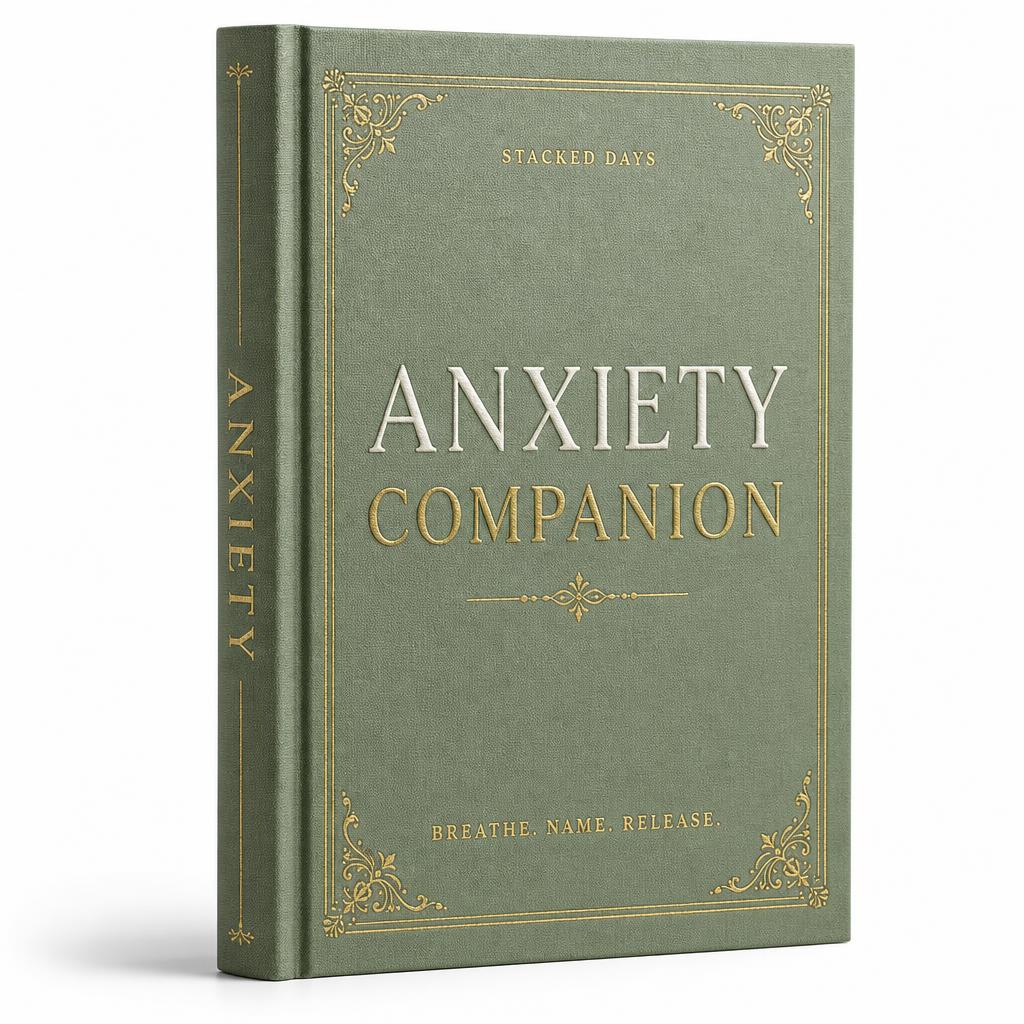
If one of these unlocks something, you don't need the other four. The Anxiety Companion Journal expands these into a full 30-day practice — but you can start, completely free, with a notebook and the next ten minutes.
Frequently asked
Questions readers ask
- How long should I journal when I'm anxious?
- Three to five minutes is enough. The goal isn't to write everything — it's to interrupt the loop. Set a timer if you tend to spiral on the page.
- Does journaling actually reduce anxiety?
- Research from the University of Rochester and other groups shows expressive writing reduces rumination and lowers physiological stress markers when practiced regularly, even just a few minutes a day.
- Should I re-read what I wrote?
- Not for the first 30 days. Re-reading too early invites self-judgment. Just write, close the journal, and trust the process.
Author
The Stacked Days Team
We make slow-made digital journals, planners, and trackers for anyone choosing to live a little more on purpose.